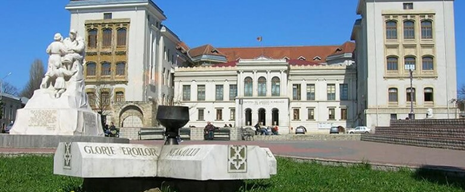
“Grigore T. Popa” University of Medicine and Pharmacy, Iasi, Romania
Faculty of Dental Medicine
The Faculty of Dental Medicine in Iasi was created in 1945 as a section of the Faculty of Medicine, under the guidance of Prof. Dr. Nicolae Dutescu, being the first with this profile in the country. Since 1965 it has been working as an independent faculty, with courses lasting 6 years. After 1989 and especially since 1992, the faculty has undergone a continuous development process, by increasing the number of teachers and the number of students and by modernizing the specialized clinics and equipping them with a modern material base, in accordance with the demands of the third millennium.
The Faculty of Dental Medicine in Iasi is an academic institution structured and organized according to modern principles, being also one of the most prestigious medical faculties in the country – at regional, national and even international level. Its history has been influenced by numerous personalities from Romanian medicine, and many of his graduates now represent significant names for Romanian and international dentistry. Its honorable past and dynamic and modern present are the preconditions for a bright future. Since 2009, faculty of Dental Medicine has set up English and French language study departments, which are open to students from all over the world. The total number of students on the Faculty of Dental Medicine is 1803, excluding the students that are registered in the College of Dental Technical Specialization.
In “Grigore T. Popa” University of Medicine and Pharmacy, Iasi, Romania Faculty of Dental Medicine there are three departments including relevant element disciplines:
- Department of Surgical /Dentoalveolar and Maxillofacial Surgery with component disciplines: Dental-Alveolar Surgery Anesthesia, Sedation And Urgent Medical-Surgical, Oral And Maxillofacial Surgery, Anesthesiology, Basics Of Physics And Biophysics In Dental Medicine, General Pathology And Gold-Maxillofacial, Chemistry And Biochemistry Of The Oral Cavity, Gold-Tooth Prevention, Community Dentistry, Oral medicine, Oral Dermatology, General and Dental Radiology, Pedodontics and Orthodontics and Dental-Facial Orthopedics;
- Dentistry-Periodontology, Fixed prosthesis with component disciplines: Cariology, Endodontics, Periodontology, Fixed prosthesis. Gnathology, DSF Aesthetics;
- Implantology, Removable Prosthesis, Denture Technology with component disciplines: Implantology and Implant Rehabilitation, Partially Removable Prosthesis, Rehabilitation of Partial Edentation, Total Prosthesis, Dental Prosthesis Technology, Dental Materials, Gold-Dental Diagnosis and Gerontostomatology, Ergonomics, Psychomotor and Speech Therapy Recovery, Balneophysiotherapy and Oral Functional Recovery, Public Health and Management.
In “Grigore T. Popa” University of Medicine and Pharmacy, Iasi, Romania Faculty of Dental Medicine there are Batchelor and Master degree programmes.
Batchelor degree programmes include:
- Dental Medicine profile specialization with long term education (6 years) and
- Short Term Education (3 years) for the complementary professions Dental Technicians and Dental Prophylaxis Assistants.
At the end of the two study cycles students in Dental Medicine profile specialization are assessed by the Bachelor Examination, with the aim of obtaining the title of Dental Doctor (MD).
The Bachelor exam consists of the following stages:
- Theoretical examination – grid test
- Practical examination
- Diploma paper
The Bachelor of Dental Medicine in Iasi is recognized by the Romanian Ministry of Education, as well as by specialized bodies in other countries around the world: member countries of the European Union, USA, Canada (since 2007), Egypt, United Arab Emirates, Germany, Greece, India, Jordan, Iraq, Iran, Israel, Kuwait, Lebanon, Morocco, Oman, Qatar, Syria, Sudan, Sweden, Tunisia, Turkey, and Yemen.
Bachelor Programme
The first and second year students training curriculum at the Faculty of Dental Medicine mainly consist of subjects associated to fundamental and general medical disciplines. This way proper premises for a complex integrative training of the future practitioners can be created.
In the time of the third academic year the number of clinical disciplines increases. Students are introduced to clinical situations through simulation treatment activities, and in a further stage of training process they apply skills acquired on treatment of real patients.
Dental disciplines come together with medical ones during next years of education. They are taught as follows:
- 3rd year specialized disciplines: Odontotherapy II, Oro-dental Diagnosis, Occlusology, Periodontology I, Preventive Dentistry, Prosthodontics – Single tooth restoration, Geriatric Dentistry
- 4th year specialized disciplines: Anesthesia and Sedation in Dental Medicine – Anesthesiology, Oral Surgery, Endodontics, Pediatric Dentistry, Prosthodontics-Fixed Dental Prothesis, Prosthodontics-Removable Partial Denture. Acrylic Denture, Prosthodontics-Complete Denture
- 5th year specialized disciplines: Oral and Maxilllo-Facial Surgery, Orthodontics and Dentofacial Orthopaedics, Periodontology II, Oral Pathology, Prosthodontics – Cast Removable Partial Denture
The 6th year training is focused on specialty practice in Odontotherapy, Endodontics, Periodontology, Aesthetics in Dental Medicine, Prosthodontics-Fixed Dental Prothesis-Ceramic Restorations, Prosthodontics-Removable Partial Denture, Prosthodontics-Complete Denture, Implant prosthodontic Therapy, Prosthodontics-Maxillofacial Prothesis, Orthodontics and Dentofacial Orthopaedics, Pediatric Dentistry, Medical-Surgical Emergency in Dental Medicine, Oral and Maxillofacial Surgery, Rehabilitation with Surgical Lasers in Dental Medicine, Oral Surgery.
In the course of this last year Management of Dental Office: Ergonomics-Oral Public Health and Dental Management, Management of Dental Office: Ergonomics-Management of Devices, Materials and Maneuvers in Dental Office, Robotics and 3D simulation are also part of the curriculum.
Computer and related technology skills knowledge. are achieved during the first year in the discipline of medical informatics and biostatistics, where students get acquainted with the basic techniques of statistical analysis on medical data sets and of course with the use of the most important computer programs.
For the clinical disciplines in their simulation module, students perform the main maneuvers on modern state-of-the-art simulators as well as on some Dentsim-simulators. DentSim 3D computer simulators are the world’s most advanced type of dental surgery simulators and offers all the advantages of a hands-on clinical working session, which it combines with the virtual simulation environment, the use of the highest quality dental instruments, the full computerized monitoring system of dental maneuvers and 3D graphics facilities for digital rendering of the working session.
As modern dentistry is governed by digital aspects, more and more it becomes obvious to accommodate the student to this register. An eloquent example is offered by dental prosthetics which brings together in its infrastructure optical impression, a CAD-CAM system, computerized axiography and a dentscan. It is important to mention that our university has implemented an extensive digitization project which will be reflected in the optimization of the infrastructure in both preclinical and clinical disciplines.
Patient records are kept using a clinic computer system with multiple facilities – recording of patients’ clinical data in an intranet system, image retrieval and storage, free access to the Internet – which contributes to the creation of a valuable information data and efficiently assists medical activity.
The implementation of projects with European funding has also allowed the creation of IT tools useful in assisting the teaching process – two e-learning computer platforms, DENT_CURSURI, with material support in virtual atlas format, for course assistance on most of the specialist subjects and DENT_STAGII, a vast collection of dental activities presented at a descriptive level, used as preliminary preparatory material for students during practical training.
The two platforms have a modular structure and multiple functions; in addition to the online resources themselves, they also contain Library modules, for uploading new teaching materials, Online Testing and Virtual Community, with Forum for discussions, Internal E-mail, Calendar and News functions.
Dental impressions are made by intraoral scanning, which accurately reproduces the anatomical features of the patient’s oral cavity.
The generated 3D model can be sent directly to a fully equipped CAD-CAM system, which enables high-quality prosthetic work to be carried out.
The practice is also equipped with a DentSCAN 3D model scanner, which is equally compatible with the CAD-CAM system. Using the unique “Axiom” technology, the most accurate post-implant restorations can be achieved by identifying the precise position of dental implants based on the scanned data. The KAVo Arcus Digma computerized axiography system, useful for rapid and accurate detection of jaw movements, necessary for correcting malocclusions and achieving a functional chewing surface. The EasyShade spectrophotometry system for recording tooth color, which guides the student towards the correct acquisition of these elements, an intrinsic condition for obtaining highly demanding prosthetic restorations.
Teaching methods are dichotomized into courses and clinical internships. The courses are based on PowerPoint presentations that may include videos relevant to issues discussed. Both video recordings and clinical scenarios are found in the manner of conducting clinical internships through the platforms developed within the framework of two European projects. It is also necessary to mention that videos are used to present clinical activities or algorithms, students can see them on the screens as an aid to clinical activities. The virtual patient will be part of the future methods of conducting clinical internships, and there are currently several projects in the pipeline.
Master programmes
Depending on the chosen specialization, Master’s programmes last 2 or 4 semesters, with 30 credits being accumulated during each semester. Candidates for the Master’s program must submit their application with the necessary documents to the Dean’s Office between 1 and 15 September.
Admission to the Master’s program is based on an interview between 25 and 29 September and courses start in October. The final evaluation is based on an exam and a dissertation, which is a personal research project. Tuition fees vary between EUR 500 – 700/year, depending on the chosen specialization, taking into account its complexity and the material base involved.
| Accredited specializations: |
Duration / no. of credits |
| Implant Prosthetic Rehabilitation of Edentulousness |
2 years
(120 credits) |
| Non-Invasive Methods of Diagnosis and Treatment in Dentistry |
2 years
(120 credits) |
| Laser Therapies |
2 years
(120 credits) |
Soft Skills Teaching And Learning
Soft skills are taught in the preclinical areal of study. Soft skills are component of the following disciplines: Behavioral Sciences, Medical Psychology, Medical Sociology, Medical Communication, Scientific Research Methodology, Bioethics and Deontology. Knowledge acquired enable further student-patient communication and clinical practice management.