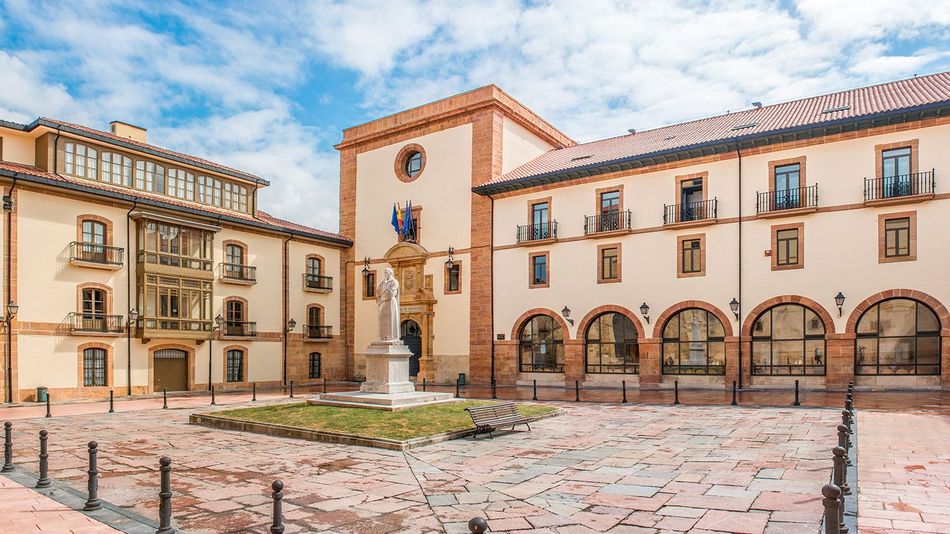
The foundation of the University of Oviedo was possible thanks to the will of Fernando de Valdés, Archbishop of Seville, Inquisitor General and President of the Council of Castile, in accordance with his will and codicils issued in 1566 and 1568.
The university institution enjoyed jurisdiction by bull of erection, which together with the execution, was issued on October 15, 1574 by Pope Gregory XIII. Both were issued in the month of November of the same year. The academic institution was born under the patronage of King Felipe III, at the request of Valdés himself, as established in the royal pragmatic signed on May 18, 1604. In that same year, the royal pragmatic of Philip III confirmed the papal bull and the building. It is solemnly inaugurated on September 21, 1608, the feast of San Mateo.
Initially, the construction housed the studies of Arts, Canons, Law and Theology with barely a hundred students and its operation was governed by the so-called Old Statutes, delivered to the university by the testamentary executors of Valdés in 1607 and confirmed by the king in 1609.
In the course of the 17th century, not without difficulties, the studies in the Oviedo academy were established. In 1618, the first modification of the Statutes took place and, in them, changes in the university organization were included, which basically affected the teachings and issues related to the government of the institution that were not included in the primitive statutes. The economic hardship was constant during the first half of the century, although it was slightly alleviated by King Felipe IV, who granted new income to the university and thus achieved the consideration of re-founder of the Oviedo Academy.
During the eighteenth century, the academic institution will experience, for the first time in its history, moments of great splendor. The century began with a new legal instrument, promulgated in 1707, intended to govern academic life, the so-called New Statutes, which are, in reality, a transfer of the aforementioned Statutes of 1618. During this century, the ideas of the Enlightenment They will have a notable weight in academic activity and will translate into initiatives of the greatest interest.
In 1709, Fray Benito Jerónimo Feijoo arrived in Oviedo as a reader at the Benedictine monastery of San Vicente. His presence in the monastery and in the university chair and his contacts with enlightened people from the city constitute a true stimulus for the society that surrounded him. It is here where he writes two of the most influential works of the Spanish 18th century: the Universal Critical Theater and the Erudite and Curious Letters., which give great renown to Oviedo and its university. Accompanied by other monks from San Vicente and a few more from other religious orders, he introduced Enlightenment ideas to the university and Asturian society that years later would bear fruit in splendid achievements, some of which, such as the new library of the university and the study plan of 1774, became a reality at the hands of another illustrious Asturian, Pedro Rodríguez de Campomanes.
The new Manuel Reguera library. On top of the old university bookstore, poor in funds and diminished in space, a new bibliographic establishment is going to be erected, the embodiment of the most genuine Enlightenment ideas. With the money earmarked for the construction of a library at the Colegio de San Matías, of the Company of Jesus, which the Jesuits rejected, Campomanes ordered that this money be used to establish a new library at the university. The works, carried out with the contribution of the General Meeting of the Principality, began in 1765 and the library was opened to the public in 1770 with select collections that increased considerably until the end of the century. The newly created library was installed on the new floors built on the south and west sides, according to the project and plans of the great architect of the Asturian Enlightenment, Manuel Reguera. This new bibliographic space constitutes the first major modification of the university building since its foundation.
The innovative curriculum of 1774. Education was one of the great concerns of enlightened men and those heroes, among which Campomanes stands out, dedicated their efforts to its reform. The reforms undertaken by Felipe V and Fernando VI paved the way for the great transformations that were to take place under the reign of Carlos III, the most important of which was the entry into force in 1774 of a new study plan, highly innovative in terms of many aspects, particularly in what refers to new study methods and the radical change of the textbooks used until then in the four existing faculties. In 1786, Medicine studies were established, endowed with two chairs at the impulse of Bishop Agustín González Pisador, which had an ephemeral life since they disappeared in 1806.
XIX century can be described as bad start, good end. The 19th century began on the wrong foot for the University of Oviedo and ended with its important role in the Spanish sphere.
The war against the French. The war against the French seriously affected, from 1808, the Oviedo academic institution. During part of this period, classes were suspended, the building was looted, furniture and household items were lost and, above all, the library was damaged, from which the most valuable books and an exceptional coin, which had been the property of the Society of Jesus and had been guarded in its Oviedo College of San Matías until the expulsion of the Jesuits in 1767. To the serious loss of an important part of the assets of the university, due to the war events, was added a bad administration of the funds and properties of the institution. For this reason, the educational center enters a prolonged period of decline, accentuated by the absolutist provisions dictated by Fernando VII, the liberal university
The end of the Old Regime and the introduction of liberal doctrines in Spain brought about a notable change in the Spanish university. The entry into force, in 1845, of the new education law, known as Plan Pidal, since the then Minister of the Interior was the Asturian Pedro José Pidal, first Marquis of Pidal, entailed a notable reform of the universities. New faculties were created, others were modernized, scientific studies were promoted and measures of a different nature were taken, which made educational institutions more flexible.
In Oviedo, the scientific disciplines began to be cultivated with more intensity, in close union with the chairs that taught studies of this nature in the Economic Society of Friends of the Country of Oviedo, and the Physics, Chemistry and Natural History Cabinets were created. , in addition to an important Botanical Garden, without forgetting the tower-observatory built a few years later by the rector León Salmeán and erected in the place occupied by the old belfry of the university chapel. Although these first scientific studies, established in the mid-19th century, were soon suspended, the aforementioned cabinets and the observatory continued to develop their activities and were the seeds for Science studies to be definitively established in Oviedo at the end of the century.
The Oviedo group and the university extension. With that single faculty, the Oviedo university became famous throughout the country. In it, in the last years of the 19th century, a cultural and pedagogical renovation movement of great encouragement was born, promoted by a faculty faculty whose formation was notably influenced by Krausist ideas, inspiring the pedagogical principles in force in the Institución Libre de Enseñanza, founded by Francisco Giner de los Ríos, without forgetting ideological elements of a regionalist and conservative nature. The most prominent names were Leopoldo García Alas -Clarín-, Aniceto Sela y Sampil, Adolfo González Posada, Adolfo Álvarez Buylla, Rafael Altamira y Crevea from Alicante, Fermín Canella y Secades, Félix Aramburu, Víctor Díaz Ordóñez, Justo Álvarez Amandi, Guillermo Estrada and Rogelio Jove. These great men wanted to put into practice the new ideas emanating from the Institución Libre de Enseñanza. These ideas were not only limited to the use of new pedagogical methods within the academic entity itself, but also sought, among other innovations, for teaching to leave the university walls and spread among the humblest layers of the population.This doctrine, with its message of popular culture extended to all social classes, which received the name of University Extension, together with a historically based cultural neo-Hispano-Americanism, are the dominant notes of the pedagogical renewal movement that developed at the University of Oviedo. at the end of the 19th century. The Oviedo group, as this group of renovating professors was called, had an enormous echo in national and international arenas, arousing unanimous admiration and praise for their courage in putting such innovative ideas into practice in the face of the cultural negligence of the country. The social repercussion of this phenomenon was enormous, not only in Asturias, but throughout Spain, and this modality of popular education spread rapidly among several universities in the country. Although some of those great figures from the University of Oviedo died early and others went to Madrid, so it can be said that the movement cooled down after 1910, our university continued to enjoy, despite its small size, remarkable prestige throughout Spain, strengthened by the increasingly notable presence of the Faculty of Sciences. In times of the Second Republic, the Oviedo center continued to count on illustrious professors in the legal, scientific and humanistic fields and was directed by the rector Leopoldo Alas Argüelles, son of Clarín, the famous writer.
Twentieth century. A troubled century. The academic institution is affected during the 20th century by two historical events that profoundly mark its development: the Revolution of 1934 and the Civil War. The century, which begins with enormous losses for the University of Oviedo, culminates with a consolidated expansion in studies and centers that extend from the capital to the Gijón and Mieres campuses.
The university, fuel for flames. The teachings were concentrated in the old university building erected from 1574 and in the attached Science pavilion, built in the early years of the 20th century. To this complex was added the Colegio de Niñas Huérfanas Recoletas and the attached chapel of San Sebastián, erected in the second half of the 17th century and ceded to the University by the city council at the end of the 19th century. The primitive nucleus of the University of Oviedo was completed with the Colegio de San Gregorio, demolished at the beginning of the 20th century, on whose site the headquarters of Banco Asturiano was built. The largest and most valuable part of this primitive university campus suffered terrible damage on October 13, 1934, during the uprising of the unions and left-wing parties against the government of the Republic. Only the Science building was spared from destruction. The university, like the rest of the city, was in the hands of the revolutionaries who turned the building into an ammunition depot. That same day, before the revolutionaries left Oviedo, fire took over the university building. In addition to the enormous damage suffered in the building, it was necessary to add the disappearance of the secular patrimony that the University of Oviedo had treasured since its founding, in the last years of the 16th century, and since the implementation of its teachings, in the year of 1608.
The scars of the Civil War. Immediately after the events of October 1934, the Ministry of Public Instruction decided to undertake the restoration works of the university building, for which it commissioned a project from the architect José Avelino Díaz y Fernández-Omaña. The works were approved with all speed, on January 22, 1935, and were affected by the outbreak of the Civil War. The impacts of cannons and aviation bombs produced significant damage to the construction, which was practically finished, for which reason new repair reports had to be drawn up and urgent works carried out. It is noteworthy that the University of Oviedo was installed in the Casino de Navia while the Civil War in Asturias lasted. With all these delays, the main building was not opened until the mid-1940s, so the classes and other academic activities were spread over different buildings and flats in Oviedo. The building of the Colegio de Huérfanas Recoletas was also rebuilt, although not the chapel of San Sebastián. With regard to the pavilion that housed the Faculty of Sciences, there was a project for its restoration drawn up in 1937. It was thought to install the Faculty of Philosophy and Letters in it while it was agreed to build a building for the Faculty of Sciences in the Llamaquique neighborhood. That primitive Science pavilion was finally demolished in the fifties and a new one was built, according to the project of Francisco Casariego, completed by Joaquín Cores. although not the chapel of San Sebastián. With regard to the pavilion that housed the Faculty of Sciences, there was a project for its restoration drawn up in 1937. It was thought to install the Faculty of Philosophy and Letters in it while it was agreed to build a building for the Faculty of Sciences in the Llamaquique neighborhood. That primitive Science pavilion was finally demolished in the fifties and a new one was built, according to the project of Francisco Casariego, completed by Joaquín Cores. although not the chapel of San Sebastián. With regard to the pavilion that housed the Faculty of Sciences, there was a project for its restoration drawn up in 1937. It was thought to install the Faculty of Philosophy and Letters in it while it was agreed to build a building for the Faculty of Sciences in the Llamaquique neighborhood. That primitive Science pavilion was finally demolished in the fifties and a new one was built, according to the project of Francisco Casariego, completed by Joaquín Cores.
The university also acquired numerous artistic assets to recover the splendor of the institution prior to the events of 1934 and an exquisite library to replace the old bibliographic establishment.
Expansion beyond Oviedo. Once the danger of transferring university studies to Santander had been overcome, the authorities started the reconstruction of the university and took a series of measures that affected teaching. In 1939, the Faculty of Philosophy and Letters was created, which was added to those of Law and Sciences, and the former León Veterinary School, converted into a Faculty in 1944, was incorporated into the university district of Oviedo. university, the School of Local Administration and the Social School. In 1958, the building of the Faculty of Sciences was inaugurated in Llamaquique, the first center to be separated from the initial university core, and which began an expansive process that has continued practically to this day. Others were added to this building on the different Oviedo campuses, on the Gijón campus and on the Mieres campus, to host the different teaching and research activities of the university institution. Most of the buildings are new, but historical buildings of great architectural value from the 18th, 19th and 20th centuries were also acquired, among which the 18th-century extension of the old San Vicente Monastery and the Palace of the Quiros Benavides family.
New studios and centers for new times. The great emergence of the University of Oviedo occurred in the seventies of the twentieth century. On the one hand, as established in the new General Education Law of 1970, centers until then unrelated to it were incorporated into the University, such as the Technical and Professional Schools, which in the case of the University of Oviedo were the School Higher Technical School of Mining Engineers, the Professional School of Commerce and the School of Teaching in Oviedo, the School of Industrial Experts and the Professional School of Commerce in Gijón and the former School of Mining Foremen in Mieres. On the other hand, new centers are born, the Faculty of Medicine, created in 1968, was the first of them and was followed by the Faculty of Economic and Business Sciences, in 1975.
In 1976 the division of Philosophy and Educational Sciences was created, with three sections: Philosophy, Psychology and Pedagogy.
In 1982, the Faculty of Philosophy and Letters broke up into three different faculties: Philosophy and Education Sciences, Philology and Geography and History. This situation will remain until 2009, when the three centers are regrouped again in the Faculty of Philosophy and Letters, with the exception of Educational Sciences, which had been established as a faculty in 1994, barely three years after the conversion. of the specialty of Psychology in an independent faculty. By agreement of the Governing Council on December 22, 2009, the Faculty of Teacher Training and Education was created, which integrates the former Faculty of Educational Sciences and the University School of Teaching.
Within the Faculty of Sciences, the Geology Section was launched in 1958. The Biology Department was born in 1961 with its headquarters in León, which then belonged to the university district of Oviedo. In 1968, two sections were created within the same university, one for General Biology in Oviedo and the other for Animal Biology in León. By ministerial order of February 5, 1982, all sections of the Faculty of Sciences became independent centers and thus the Faculties of Chemistry, Geology and Biology were created.
Several centers were opened on the Gijón campus. On the one hand, in 1979, the official status of the Gijón Nautical School was established, which would later become the Superior School of the Civil Navy. The integration of this in the University of Oviedo, as it happened in all of Spain, begins with Law 23/1988 of July 28, to comply with what was provided for in the University Reform Law of 1983. On the other hand, The Polytechnic School of Engineering emerged in 2010, the result of the merger of the Gijón University School of Industrial Technical Engineering with the Gijón University School of Computer Engineering and Telematics and the Gijón Higher Polytechnic School of Engineering. In that same year,
The School of Mining Technical Engineering of Mieres became the University School of Technical Engineering, with the specialties of Mines, Forestry and Topography. These degrees were joined by the Guillermo Schulz Higher Polytechnic School to teach the second cycle of Geological Engineering, already in the new building on the Mieres Campus, which had been built in 2002. All the degrees taught in Mieres are finally integrated into the new School Polytechnic in 2009.
XXI century. The University of the present that looks to the future
The University of Oviedo stands out today for the quality of its training offer and its research in all areas of knowledge: arts and humanities, sciences, health sciences, social and legal sciences, and engineering and architecture. The institution is made up of eleven faculties, six schools, and three associated centers, spread over the three cities—Oviedo, Gijón, and Mieres—where its campuses are located.The University of Oviedo is immersed in a transformation process with a view to optimizing university infrastructures, both from the point of view of adapting to the new reality of university degrees and administrative organization and from the point of view of maintenance and conservation of its extensive historical heritage and the facilities that make it up, seeking to improve quality in the teaching, research and knowledge transfer fields and following sustainability and environmental protection criteria.
The strategy is embodied in a general program aimed at transforming university campuses into a knowledge environment where quality of life, environmental sustainability, the aggregation of agents and institutions, student services and urban planning make the university spaces in a referent for the Asturian society.
Institutes and other centers
The University of Oviedo is structured into centers and departments, where teaching is given and research is carried out. In addition, it has a series of centers, institutes and more specialized services.
Institutes and centers
· Institute of Space Sciences and Technologies of Asturias (ICTEA)
· Institute for Educational Research and Innovation (INIE)
· Institute of Neurosciences of the Principality of Asturias (INEUROPA)
· Institute of Natural Resources and Land Management (INDUROT)
· Feijoo Institute of 18th Century Studies
· University Institute of Biotechnology of Asturias (IUBA)
· University Institute of Business (IUDE)
· University Institute of Oncology (IUOPA)
· University Institute of Organometallic Chemistry “Enrique Moles” (IUQOEM)
· University Institute of Industrial Technology of Asturias (IUTA)
· University Institute on Gender and Diversity (IUGENDIV)
· Avilés University Services Center
· Center for Territorial Cooperation and Development (CeCodet)
· Artificial Intelligence Center
· Center for Research in Nanomaterials and Nanotechnology (CINN)
· Mixed Biodiversity Research Unit (UMIB)
· Martínez Marina Constitutional History Seminar
Departments
The University of Oviedo is organized into 38 Departments of the five branches of knowledge, to which most of the personnel that carry out research work are linked. The knowledge areas are Arts and Humanities, Sciences, Health Sciences, Social and Legal Sciences, Engineering and Architecture. The departments are the teaching and research units in charge of coordinating the teaching of one or several areas of knowledge, in one or several centers, in accordance with the university’s teaching programming, of supporting the teaching and research activities and initiatives of the teaching staff, as well as to exercise those other functions entrusted to it by these statutes or current legislation.
Teaching in the University of Oviedo is in faculties, schools and centers listed below:
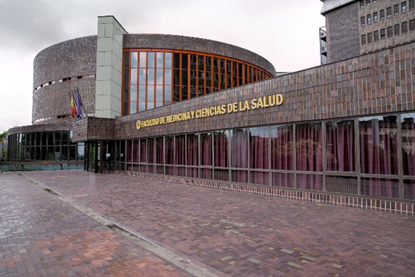
· Faculties: Biology, Sciences, Commerce, Tourism and Social Sciences Jovellanos, Right, Economy and Business, Philosophy and Letters, Teacher Training and Education, Geology, Medicine and Health Sciences, Psychology, Chemistry;
· Schools:Oviedo School of Mining, Energy and Materials Engineering, School of Computer Engineering, Polytechnic School of Engineering of Gijón, Polytechnic School of Mieres, Professional School of Medicine of Physical Education and Sports, Superior School of the Civil Navy;
· Associated centers: Gijón Faculty of Nursing, Father Ossó College, Doctoral School.
Degrees, masters, doctorates and own titles
The academic institution offers a total of 60 degrees in all areas of knowledge, another 60 university master’s degrees, five Erasmus Mundus master’s degrees, 25 doctoral programs and 63 own titles. But beyond formal education, the academic institution is open to society with three particularly interesting training initiatives. The House of Languages, the University Extension and the program for seniors PUMUO.
The House of Languages
The Casa de las Lenguas’s primary objectives are to enhance the linguistic offer for foreign students who come to study at the university each year and to improve language training in the university community and, by extension, in Asturian society. It is oriented, therefore, towards two main lines of action: one dedicated to teaching Spanish as a foreign language and another focused on language learning and providing translation and linguistic advisory services.
College extension
The University Extension, to overcome the barriers of more conventional training, organizes each year more than 170 cultural activities that include performing arts, concerts, conferences, competitions and awards, classrooms, exhibitions, conferences, round tables or book presentations.
Program for seniors PUMUO
The University Program for the Elderly of the University of Oviedo, better known as PUMUO, arose in the 2001-2002 academic year, with the purpose, closely linked to the very reason for being of the University Extension, of favoring the training of people over 50 years that, on many occasions and due to various circumstances, could not attend university. Since its creation in the 2001-2002 academic year, nearly 400 professors have taught. As for the student body, only during the last decade, close to 5,000 people have passed through PUMUO’s classrooms. The profile of the student body is very varied and is made up of people who have finished their working life and want to continue their training. Many of them are women who want to expand their knowledge when they have more free time.
The initiative, which began in Oviedo, has been adding venues and adapting its contents to social demand. Thus, initially two years of training were proposed, which, already in 2003, were extended to three years and, currently, to five. PUMUO participants can receive classes, in addition to the university headquarters in Oviedo, in Avilés, from the 2004-2005 academic year; in Gijón, from 2011-2012; in Mieres, from 2018-2019, and in Luarca, from 2020/2021. PUMUO is organized around subjects and workshops of 15 teaching hours each. There are a total of four subjects and two workshops per semester. Currently, the program offers training in Humanities, Legal-Social Sciences, Health and Life Sciences, and Science and Technology.
The prestige of the University of Oviedo earned it the Campus of International Excellence seal in 2009, which raised specialization in two scientific fields with the creation of two clusters: the Energy, Environment and Climate Change Cluster and the Biomedicine Cluster and Health. Both have been the starting point for promoting university research involved in the territorial environment and related to technology centers, institutions, companies and civil society, competitive and efficient in management, more international, and capable of responding to the challenges posed by the society. A third cluster, focused on the Social Sciences and Humanities,white coat .
Men and women, protagonists of the research. All this work would not be possible without taking into account the true protagonists of the research: 2,000 men and women who work synergistically grouped into 173 accredited groups, with a thriving presence of women leading these structures. The recognized research groups are constantly growing and have gone from 21 in 2010 to 173. The areas of knowledge with the largest number of groups are Physical and Analytical Chemistry, Electrical, Electronic, Computer and Systems Engineering, Computer Science, and Psychology.
The university makes the excellent infrastructures of its Scientific-Technical Services (SCTs) available to research talent. They are a set of units that provide support to researchers, groups or teams from the university, as well as other public or private entities. It has 18 units that fall into three service categories:
· Analysis Techniques : nuclear magnetic resonance, electron microscopy, X-ray diffraction, magnetic measurements, mass spectrometry, thermal tests and elemental analysis, X-ray fluorescence and electron microprobe; and photoelectron, UV-visible and IR spectrometry;
· Test laboratories : biotechnological and biomedical tests, oceanographic sampling, animal life and preclinical tests, nanotechnology (including nanoporous membranes), food technology and environmental tests;
· Technological support : photon microscopy and image processing, scientific modeling cluster, mechanical workshop and statistical consulting.
The facilities are located in Oviedo, although there are also units on the Mieres and Gijón campuses and the creation of new units in both spaces is planned in the future.
Aware of the need to adapt to changing times, the academic institution is advancing towards the university of the future. For this purpose, it has provided itself with a general strategic plan and several specialized ones – structure, research, infrastructures and academic planning – that will lay the foundations of the university of the future.